Teaching Kids to Play Moonstone
Our thanks to Mike Goril for this great article and for getting some Moonstone players hooked while they’re young!
Gotta start ‘em young!
Tabletop games are fun, but usually have a steeper learning curve and more complex gameplay compared to many board or card games. This can make it difficult for young kids to understand, resulting in frustration rather than fun. I’ve successfully taught both of my kids (ages 9 and 12 as of this writing) how to play Moonstone, so I thought I’d share my experience and hopefully get some more kids to come visit the land of Tauber!
What Makes Tabletop Games Hard for Kids?
There are a few things that make tabletop games tough for kids to get into. First is the length of a game. While Moonstone may be on the shorter side for tabletop games, a typical game can still take around 2 hours to play. For young kids, focusing and concentrating on a game for that long can be a real challenge.
Tabletop games also require complex multi-step thinking and planning. Right from the start of the game, players need to think about a strategy to execute over the next 4 turns, taking into account the board layout, the moonstone drop, their troupe’s abilities, and their opponent’s troupe. Again, for a young mind, this is a lot to take in!
Tools for determining movement in a typical board game compared to (a portion of) my tabletop game movement tools.
The basics of tabletop games also tend to be more nuanced and have more factors to consider. Consider something as simple as movement. Most board games require nothing more than rolling some dice and moving that many spaces, whereas movement in a tabletop game can use an array of different tools with specifics varying across games.
Development Steps Before Your First Game
So how do you know when a kid is ready to learn Moonstone? Step one is going to be to assess where they’re at in terms of focus and multi-step thinking. Age plays a big factor, but every child will be unique, so take their individual personalities and strengths into account.
For younger kids, say 5-8 year old range, it’ll likely take multiple steps to get them ready for Moonstone. One strategy I’ve had success with is starting with kids’ versions of more complex board games, such as Ticket to Ride: First Journey, My Little Scythe, and Catan Junior. These all have gameplay that involves both thinking ahead and considering multiple paths to victory. Once they seem like they have a solid handle on the kid versions, you can start introducing the full versions, further pushing both their thinking skills and their ability to focus for longer periods.
If it seems like they’re comfortable with these types of games, it might be time to take the next step to the tabletop!
Teaching the Basics
When I demo Moonstone to new players, I’ll often use a “progressive disclosure” strategy. In a nutshell, I’ll start with stripped-down versions of concepts, and gradually add in the details as the game goes on. This way players can gradually get familiar with each concept, rather than piling everything on all in one go. For instance, the first melee action might be very simple, with each player only playing one card, while ignoring things like distractions, critical hits, and signature moves. Then I’ll add in one or two more concepts as the players are ready.
Taking a more extreme version of this approach can be useful when teaching kids. If they have no experience with tabletop games in general, one “game” could just involve moving characters around and picking up moonstones, with the focus being more on how movement is done with rulers (rather than counting spaces like a board game) and how Energy is used to perform actions.
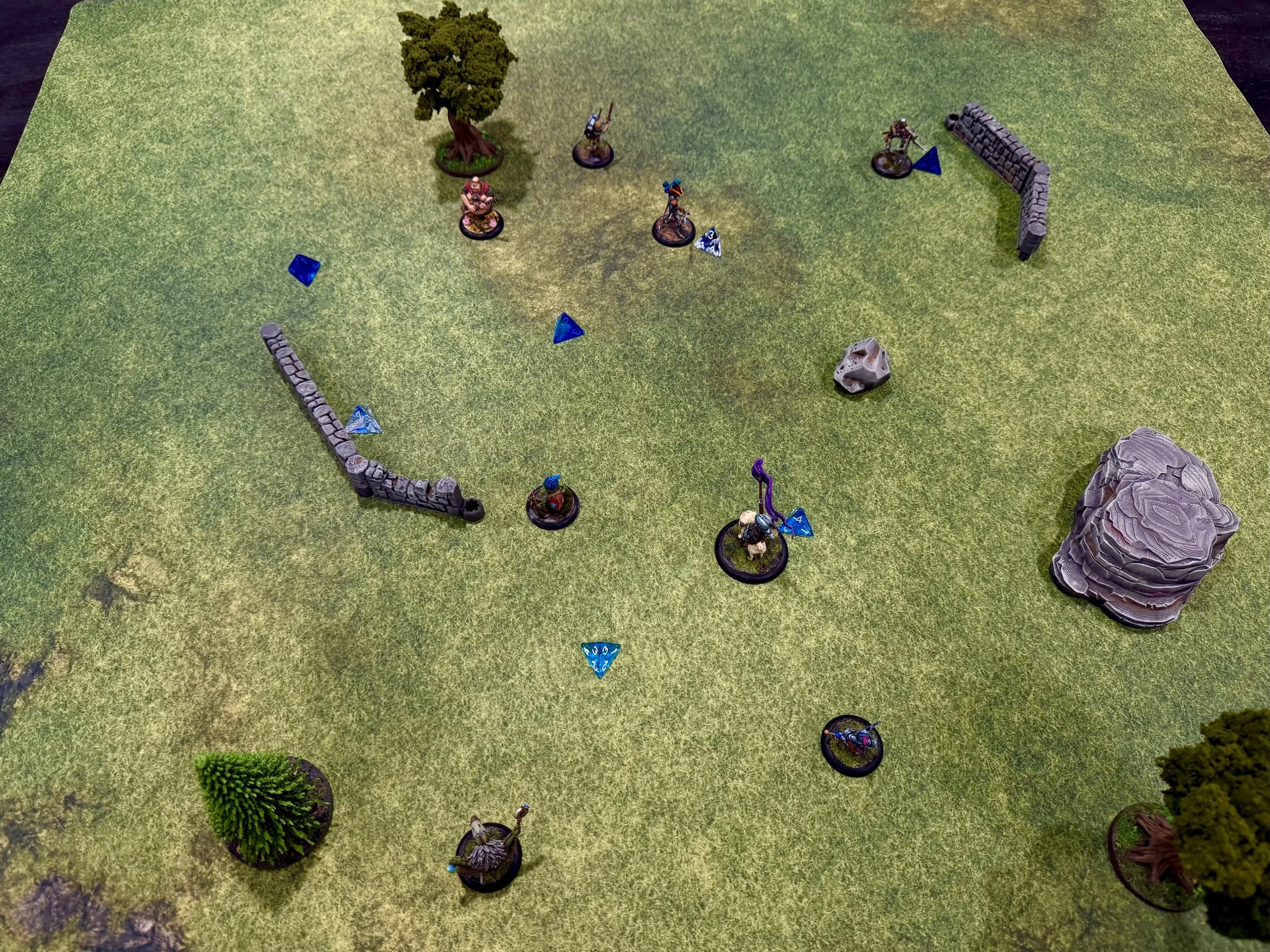
A simplified setup where the only goal is to move around the tabletop and pick up moonstones.
Next time, introduce a bigger concept, such as Arcane actions or Melee attacks. Slowly build their knowledge and experience with these bite-sized “games”, focusing on learning a new concept while building on what they’ve already learned. They should also stick to using the same characters each game, learning those characters’ abilities alongside the rules of the game. During each game, pay attention to how well they’re picking it up, and tailor your steps based on their progress.
Playing Their First Game
Once they’re comfortable with all of the basics, it’s time to play a real game! Thanks to all of the work up until this point, the first game won’t be much different than what’s usually done for new players: have each player use a troupe of 4 characters, with 5 moonstones on the board. Keep the terrain pretty basic, with just a handful of obstacles and barriers, while ignoring things like water features and wooded patches. The goal of the first few games is to focus on learning the specifics of their troupe, there are a lot of details packed into those characters’ cards after all!
One other note, do your best to try and play somewhat consistently. One mistake I made was going too long between games, and in that time, enough was forgotten that it made getting started again a little frustrating. By playing regularly, concepts that were learned can be reinforced, making the next game that much easier to tackle.
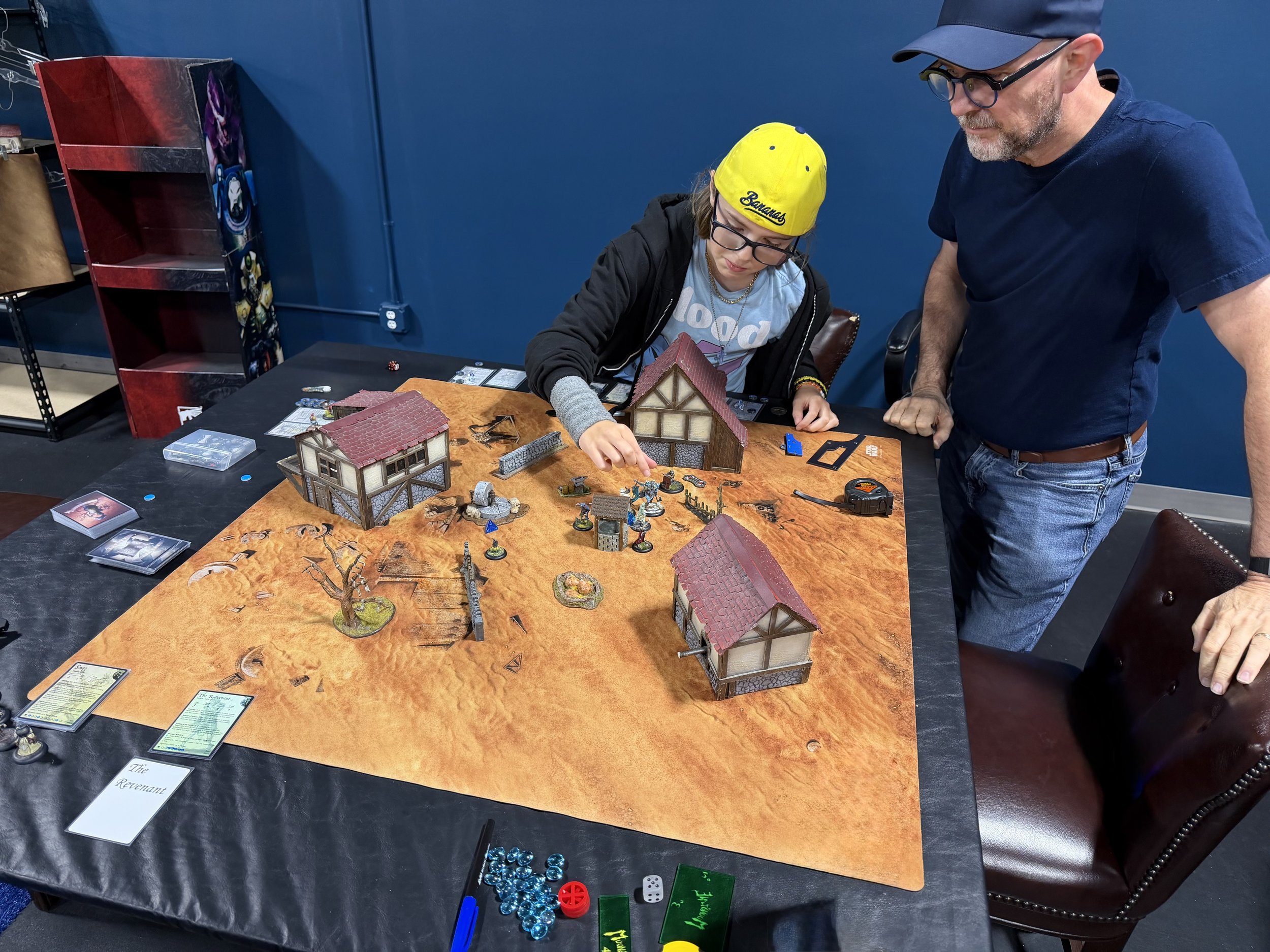
Take it step by step, and before you know it they’ll be playing against folks at the hobby shop all on their own!
Troupe Choices
Some troupes are better choices than others when learning. The Humans in the Dusk till Dawn starter set are probably the easiest to learn due to their more direct playstyle and plentiful armor. The Shades in the Life and Death starter set are also a good choice, with a play style similar to the Humans but able to be reanimated, making mistakes feel less punishing.
Gnomes are also a great place to start due to their buffs being mostly passive, and having most of their energy at the bottom of their health boxes. Fauns and Goblins can also be good starters, but will take more time to learn how to use them effectively as they have slightly more complicated play styles.
Troupes to avoid include Cultists, Witches, Faeries, Rogues, or Spirits. These troupes tend to have more complex/multi-step abilities and interactions, which may add too much to think about in addition to general strategy.
Other Scenarios to Play
Lastly, besides the standard game, there are a couple of scenarios worth mentioning (all of which can be found in the Rulebook). The first is the Sleepy Heads scenario. In this scenario, deployment of characters happens gradually over the course of the game, rather than all at the start. This can both make the game shorter, as well as reduce complexity by easing players into the game.
Second is the Double Headed Giant format. This is a 4-player format, with two teams of 2 players each. This format is great as it allows you to help your teammate out, say by giving strategy advice or helping out their characters if they get in a bad situation, without feeling like you’re “cheating”.
Third is the Wizard’s Agent scenario. Here, each team gets a moonstone at the start of the game, and the goal is to deliver it to the someone in the tavern. The simpler, more linear goal can help reduce the complexity, and the game itself can be a ton of fun as everyone starts piling up at the tavern entrance and chaos erupts!
Baby Steps
As with many things in life, patience is the key to success. While rushing right in can be tempting, it can result in overwhelming a child and turning them off from the idea completely. However, if you take it slow, be mindful of how they’re doing, and encourage them at each step, before you know it you’ll have a new player ready to fight you for those moonstones!
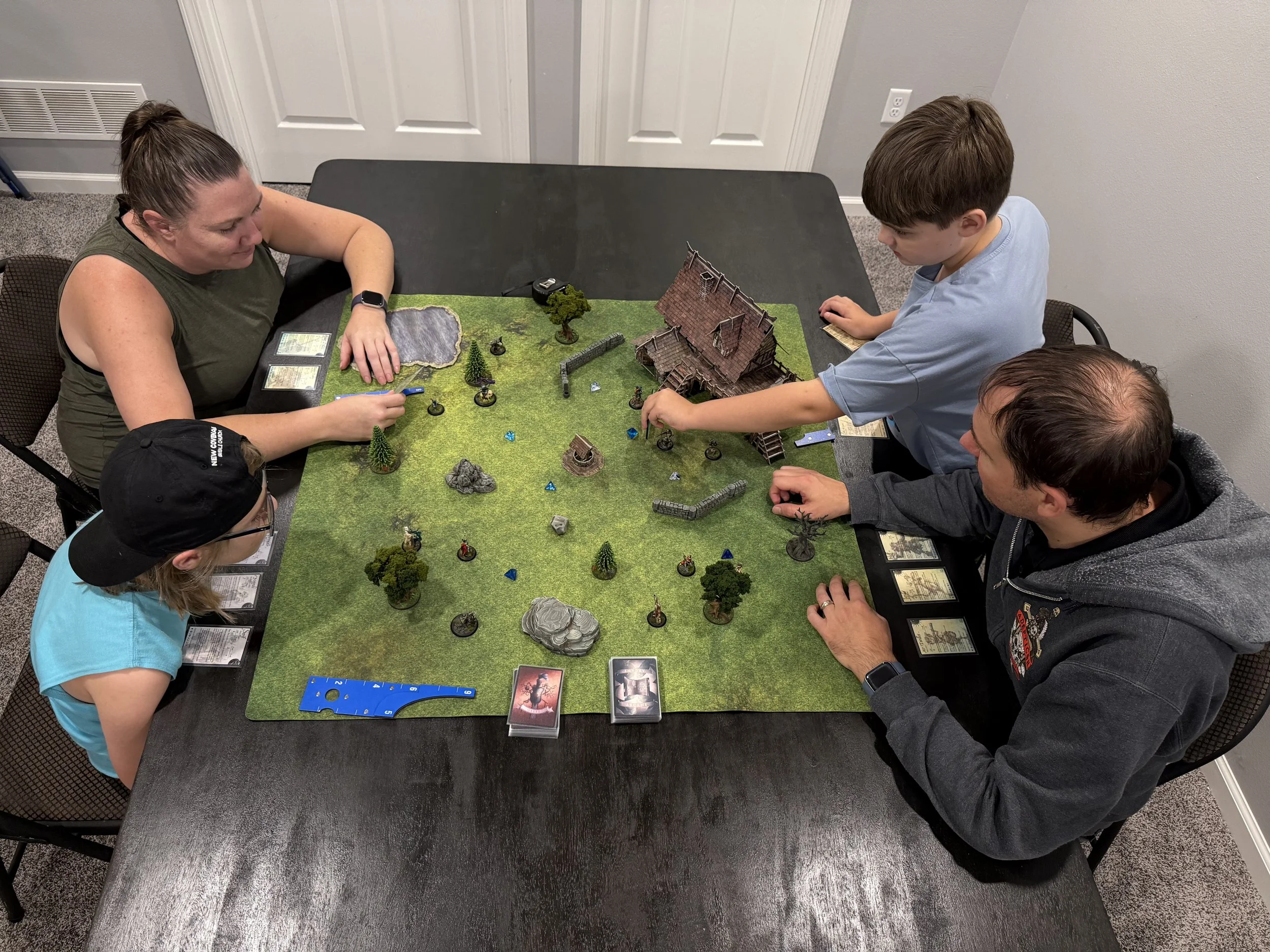
With some patience and persistence, you can take family game night to a whole new level!